From CRM chaos to investment intelligence.
How a billion-dollar software investor used a custom Salesforce implementation to streamline work, reduce operating friction, and turn its investment process into a source of intelligence.
A repository asks people to describe work they already completed.
Investors tend to shudder at the word CRM. Yet the tedious reminders surrounding it are usually evidence of something more important: the operating process and the company record have become two separate systems.
Whether the firm has ten employees or operates across many portfolios, the pattern is familiar. A meeting occurs, an offer changes, an employee leaves, or ownership moves—and then someone must painstakingly update the repository so that it resembles reality again.
The CRM can hold valuable information. The problem is that a thin company-and-contact model makes administration the price of admission. It does not have to be that way.
The framework: five levels from company repository to investment operating system.
The model is deliberately simple: an investment company consists of interconnected entities that take actions with other entities. Insight increases as the system represents more of those participants, actions, parameters, and relationships.
A target and a contact can organize a list. They cannot explain which employee moved an opportunity, what interaction established dialogue, how a contract changed the process, why ownership moved, or which conditions led to an outcome. Those answers live in the connections.
The progression begins with inventory, then adds activity. At Level 3, the investment process becomes its own record; contracts and brokers then expose progress and origination. Level 5 adds automation and historical analysis. Each level earns the right to ask a more consequential question.
Four nested levels progressively extend one connected investment model. Level one, Organized, contains investment targets and contacts. Level two, Curious, adds employees and activities. Level three, Knowledgeable, adds the investment process. Level four, Enlightened, adds contracts and brokers. Level five applies automation, history, and analysis across the complete model.
Investment target
Name, Industry, Country, Number of employees, Revenue
Contact
Name, Role, Email, Phone number
Employee
Function, Team
Activity
Type, Outcome
Investment process
Stage, Price, Start date, End date, Outcome
Contract
Type, Sign date, Price
Broker
Name, Brokerage
A Level 2 repository became a Level 5 operating model in 30 days.
The investor was one of the world’s largest software investors. Several dozen independent investment teams rolled into a smaller number of portfolios, but the system coordinating them captured only a fraction of the actual investment process.
Its gaps were operational as much as technical. Low data quality and the effort required to reconstruct a clean dataset prevented the organization from learning quickly from its own activity.
01Thin repository Targets and partial contact data formed a thin company repository; only a small share of activity was captured.
02Disconnected records Contracts, employees, and offer prices existed as disconnected or duplicated values rather than relationships.
03Manual administration Ownership changes, required fields, and inconsistent price units depended on manual administration.
04Quarterly reconstruction Excel reporting reconstructed the process for head office and the board once every three months.
Before analysis could begin
The transformation joined three changes that are often attempted separately: represent the process, govern the record, and guide employees through the work.
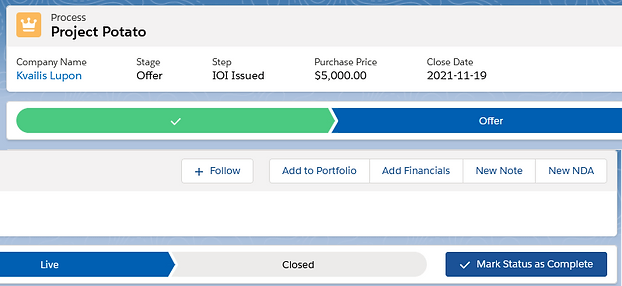
Investment-process replication
The investment process was fully replicated in Salesforce, creating a daily view of investment operations.
- Pipeline reporting became automatic across every step, milestone, and measure of deal velocity.
- Lost processes, market participants, and recurring trends became available for analysis.
- A guided workflow carried employees through the new operating procedure.
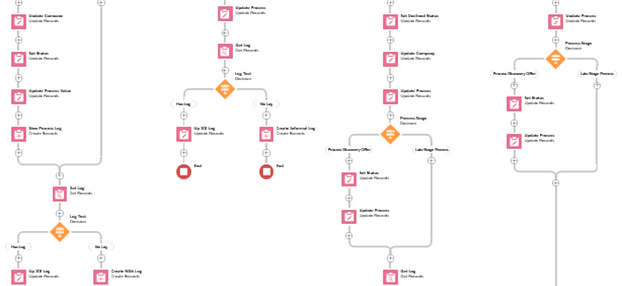
Automation and data governance
Employees no longer had to choose their own units, leave critical parameters blank, or recreate routine administrative work.
- Validation removed common errors and required the datapoints needed downstream.
- Fields populated automatically while important changes retained their history.
- A centralized support team handled administrative requests through a CRM ticket workflow.
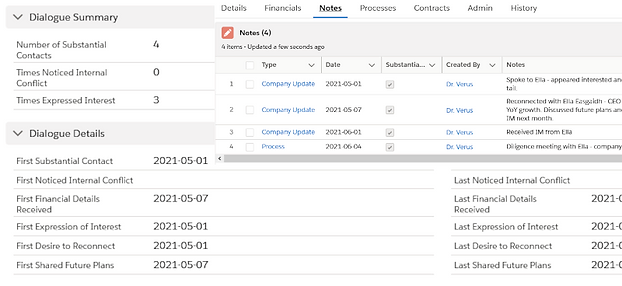
Data-model expansion
New entities, actions, and parameters captured the internal and external drivers affecting investment operations.
- Dozens of parameters created a fuller read of each operating step.
- Analyses and experiments became faster to run, easier to modify, and repeatable through time.
- The connected history opened a broader set of learning opportunities across investment operations.
The ownership-transfer workflow made the new operating model concrete.
Lead allocation created a recurring point of friction. The team that added a target received exclusive ownership for one year; after that, another team could request the company if it established dialogue. Every change required executive approval.
The policy was clear, but its execution lived in email. Requests accumulated or disappeared, evidence had to be reconstructed, multiple teams sometimes contacted the same target, and routine decisions consumed senior attention.
The rebuild made each request a first-class record and closed the decision back into target ownership. Low-quality requests stopped before escalation, the decision trail became visible, and conflict between teams fell by half.
Request
Start from the investment-target record.
Evidence
Require the contact and activity that support the claim.
Review
Route the complete request through portfolio approval.
Ownership
Update the responsible team on the same record.
Ways to extend a Level 5 investment CRM.
At Level 5, the core records, relationships, controls, and history are already connected. That foundation makes it practical to extend the CRM without creating another disconnected tool or another copy of the data.
The investment team can choose where to go further: qualify targets more precisely, add financial and third-party context, connect adjacent processes, automate reporting, or embed operating guidance in the workflow.
Lead qualification
Prioritize targets against the firm’s own criteria.
Financial integration
Keep multi-year financials and transaction structures with the process.
Third-party enrichment
Resolve market, company, and contact data to the same entities.
Process integration
Connect adjacent processes through one operating workflow.
Automated reporting
Generate reports and dashboards from the work as it happens.
Embedded guidance
Teach the operating procedure at the moment of work.
Once work created the record, reporting became a by-product of the operation.
Pipeline status, process history, data controls, ownership decisions, and reporting now resolved through one connected record. The report no longer had to reconstruct the operation before anyone could learn from it.
The implementation was built directly in Salesforce. The enduring lesson is broader: whether the incumbent system can be extended or a complementary application is required, the model, workflow, controls, and reporting must close into the same record.
- 30 days
- to complete the end-to-end operating-model transformation
- Level 2 → 5
- from a company repository to a connected investment operating model
- 50%
- less conflict between investment teams after the transfer workflow launched
- Quarterly → daily
- the shift in visibility into the investment pipeline
Continue through the operating record.
All insightsMake the work produce the record.
We can map the process, identify what the incumbent system can own, and build the missing model, workflow, and controls where they belong.